Sep 8, 2026Cold Chain Guides
Where Does a TRU Actually Absorb Heat? The Role of the Evaporator
The evaporator is the component that absorbs heat from the cargo space. Delivering that capacity depends on clean coils, correct refrigerant flow, fan performance and clear return-air paths.
It is easy to think of a transport refrigeration unit as a black box that simply makes cold air. But within the system, one component is responsible for the actual work of pulling heat out of the cargo space: the evaporator. Understanding where the heat is absorbed explains why a seemingly healthy unit can still struggle to hold temperature.
When a unit is underperforming, the instinct is often to suspect the compressor, because it is the most visible and expensive part. In many cases, however, the problem is not that the unit cannot produce capacity, but that the capacity it produces cannot reach the load. That distinction begins with a clear picture of the heat path.
The Heat Path Through the System
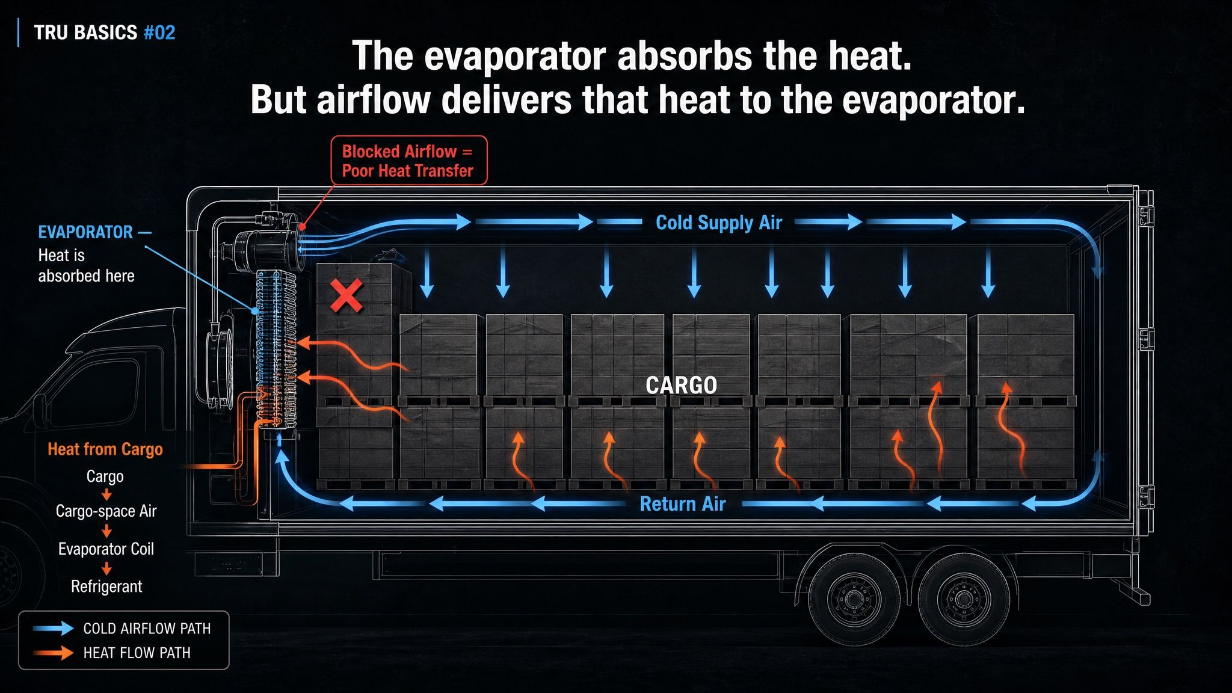
Inside the refrigerated body, refrigerant enters the evaporator at low pressure and low temperature. As air passes across the evaporator coil, heat moves in a clear path: from the cargo space, into the air, onto the evaporator, and into the refrigerant. The evaporator fan then circulates the cooled air back through the cargo space so the process continues. The evaporator is therefore the point at which heat leaves the cargo and enters the refrigeration circuit.
What Determines Evaporator Performance
Because the evaporator is the point of heat exchange, its performance depends on more than refrigerant temperature alone. For the coil to do its job, several conditions must be met: clean coil surfaces, correct refrigerant flow, good fan performance, clear return-air paths and proper cargo loading. Each of these affects how much heat can move from the air into the refrigerant in a given amount of time.
A dirty fin pack, for example, acts as an insulator between the air and the refrigerant. Correct refrigerant flow ensures the coil is fed properly across its full face. Good fan performance maintains the air volume that carries heat to the coil. And proper cargo loading keeps the supply and return paths clear so the cooled air can actually reach the load.
Why Airflow Is the Hidden Failure Point
If airflow is blocked, the refrigeration system may still be running normally, but heat cannot reach the evaporator efficiently. The compressor is working, the refrigerant is circulating, and yet the box temperature does not come down as it should. This is the trap that leads an operator to suspicion of a failed component when the real problem is a loss of airflow across the coil.
For anyone operating or maintaining a refrigerated truck, the practical lesson is to treat airflow as part of the refrigeration system, not as an unrelated detail. Loading pattern, coil cleanliness and fan condition are just as important to temperature control as the compressor or the refrigerant charge. When a unit is underperforming, checking what the evaporator can actually exchange is one of the fastest ways to find the cause and avoid an unnecessary part change.