Sep 8, 2026Cold Chain Guides
Why Is Your TRU Losing Cooling Capacity? A 4-Area Checklist
Low cooling capacity is a symptom, not a diagnosis. A four-area checklist helps a technician find where the heat-transfer process is actually breaking down.
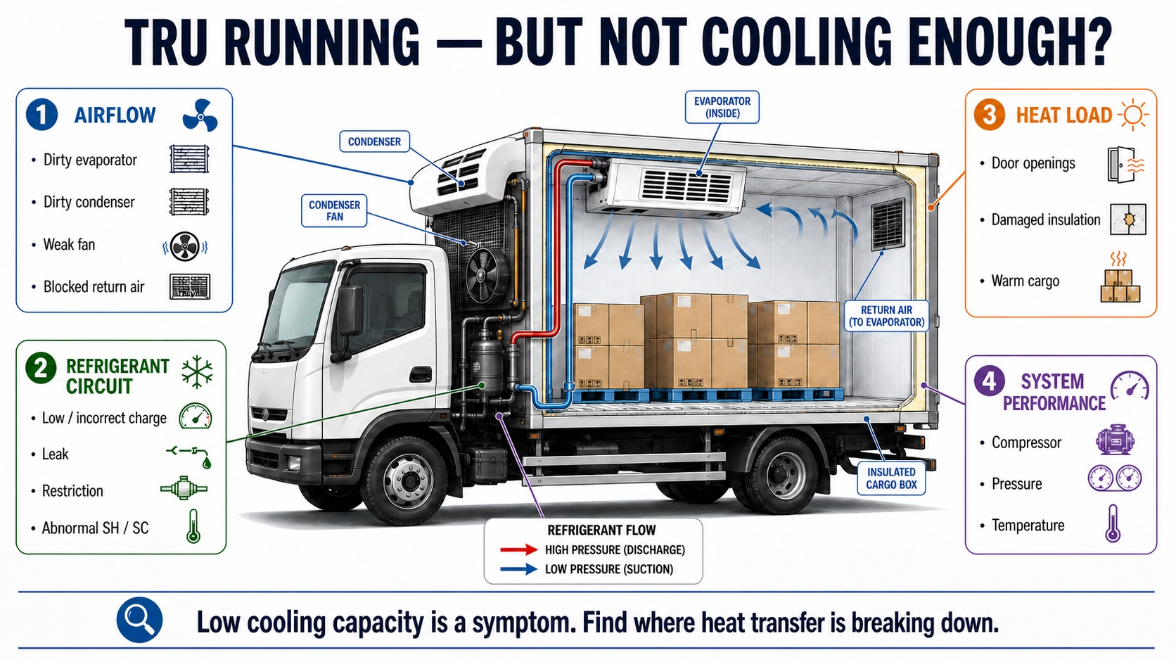
The unit is running. The compressor is running. The fans are running. Yet the box temperature takes longer and longer to come down. This is one of the most common complaints a transport refrigeration owner brings to a service team, and it is also one of the easiest to misread. Because the machine is clearly operating, the natural instinct is to start replacing parts. Before any component is swapped, it helps to treat the symptom as a signal and work through a structured checklist.
A checklist matters because a transport refrigeration unit is a complete system. Its cooling capacity is the result of several subsystems working together, and any one of them can reduce the amount of heat the unit removes from the box. Working through the system area by area is the fastest way to find where the heat-transfer process has broken down.
Area One: Airflow
A refrigeration unit can only move heat if air moves across the evaporator and condenser coils. Start with the airflow side of the system. Is the evaporator coil dirty? Is the condenser coil dirty? Are the fans weak or damaged in some way? Is cargo blocking the return-air path? Any one of these reduces the amount of heat the unit can pick up from the box and reject into the surroundings.
Of these, the return-air path is the one most often overlooked. Even a clean coil cannot work well if cargo is stacked against the airflow into or out of the evaporator. Checking the airflow path takes only minutes and can prevent a completely unnecessary component replacement.
Area Two: The Refrigerant Circuit
Next, examine the refrigerant circuit. Is the refrigerant charge correct? Is there a leak somewhere in the system? Is there a restriction in a line? Are superheat and subcooling within the expected range? The refrigerant circuit is where the thermodynamic work of the system is done, so any deviation here shows up directly in cooling capacity, and it will continue to do so even after other parts are renewed.
Areas Three and Four: Heat Load and System Performance
The remaining two areas concern the conditions the unit is asked to work against and whether it is performing as designed. Consider the heat load: are the doors being opened frequently? Is the insulation damaged or wet? Was warm product loaded into the box? Then verify the compressor and the overall system: are the operating pressures and temperatures normal for the current condition? If the load has increased or the system has drifted, capacity will fall even though the machine appears to be running.
Low Capacity Is a Symptom, Not a Diagnosis
The reason to work through these areas methodically is that low cooling capacity is not itself a diagnosis. It is a symptom. A transport refrigeration unit is a complete heat-transfer system made up of airflow, refrigerant, load and compressor performance, and a reduction in capacity can originate in any one of them.
For an operator, this checklist is a practical way to avoid unnecessary repairs. A unit that is simply restricted by a blocked evaporator or working against a warm load does not need a new compressor; it needs the correct fix applied to the right area. When a technician arrives on site, ask that the diagnosis follow the heat path rather than the price of the most likely part. That is how a cooling-capacity problem becomes a one-time repair instead of a recurring one.