Cold Chain Guides
Split vs Monoblock Transport Refrigeration Units: Which Fits Your Body?
Split and monoblock units cool the same bodies differently. The real difference is usable cargo space, installation work and service access, not capacity.
Split vs Monoblock Transport Refrigeration Units: Which Fits Your Body?
Two units with the same cooling capacity can be built in two completely different ways, and for a body builder or a fleet the difference is rarely about cooling. It is about where the hardware sits, how much of the body it takes up, how much installation work the vehicle needs, and how easily a technician can reach the components later.
This article sets out the two architectures as they are used in vehicle-powered (non-independent) transport refrigeration, and the questions that should decide between them.
The Two Architectures
In a split unit, the condenser and the evaporator are separate assemblies. The condenser mounts outside the body — on the roof, at the front above the cab, or underneath — and the evaporator mounts inside the cargo compartment. Refrigerant lines connect the two.
In a monoblock unit, the condenser and evaporator are built as a single one-piece assembly that mounts onto the body as one unit. The refrigerant circuit is contained within that assembly and is charged and tested at the factory.
Both are vehicle-powered in the sense relevant here: the compressor is driven from the vehicle rather than by a dedicated engine. That distinguishes both from self-powered units, which carry their own engine and are a separate category.
What the Manufacturer States
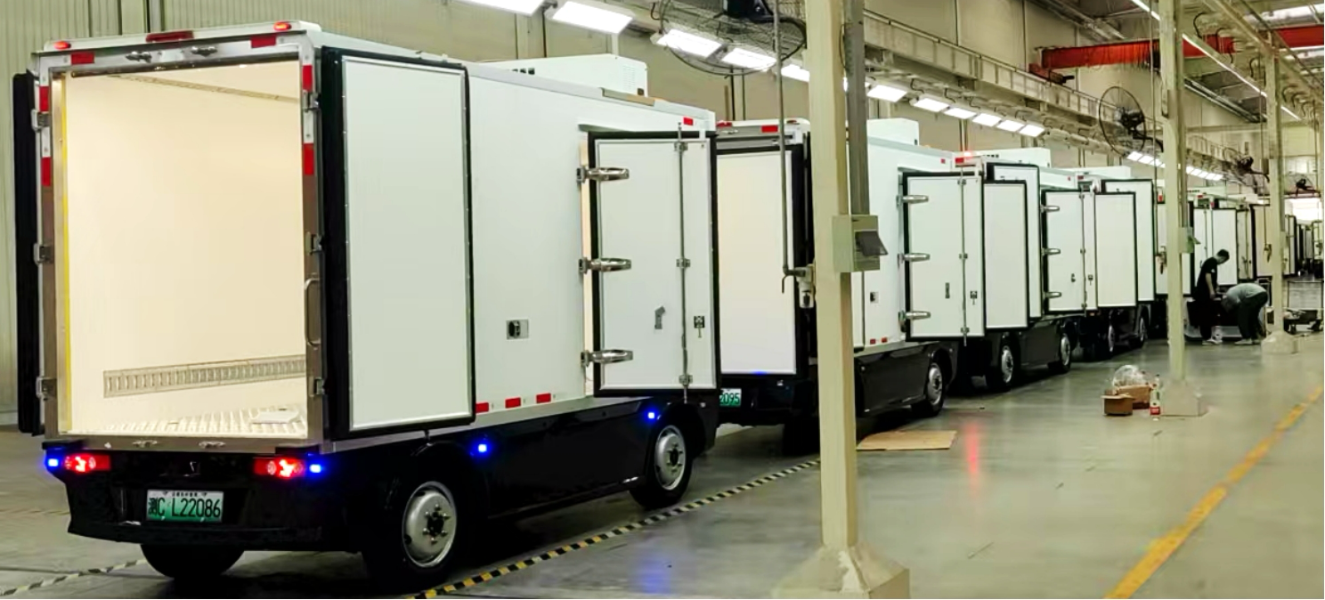
The BlackShields catalog describes the G series monoblock as a unique one-piece condenser and evaporator design, installed for heavy, medium and light refrigerated transport vehicles, and notes that it suits meat-hook, basket and carton cargo particularly well. The same catalog illustrates the space difference directly: a monoblock unit is shown with 100% loading efficiency and 0% compartment occupancy, while a split unit shows its condenser and evaporator as separate items occupying body space.
That 0% figure is the clearest single statement of the trade-off. A monoblock takes no usable cargo volume inside the body. A split unit's evaporator necessarily protrudes into the compartment, and that protrusion is volume the customer cannot load.
The Space Question
For a body of a given external size, the internal volume a customer can actually use is what they are buying. An evaporator assembly on the ceiling reduces headroom along its length, which matters most in small bodies where a few centimetres is a meaningful percentage of capacity, and matters less in large bodies where the evaporator is a small fraction of the total.
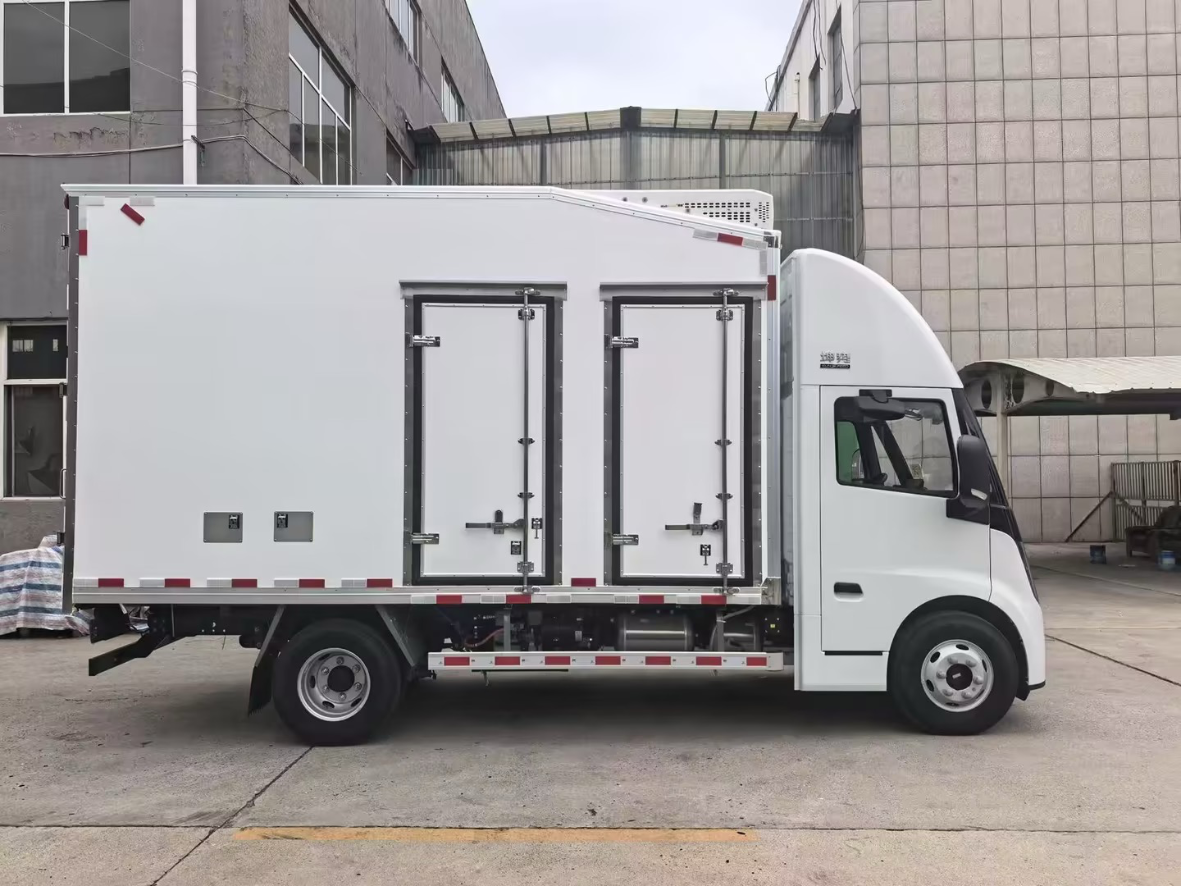
That is why monoblock designs are particularly associated with smaller and medium bodies, and why the space argument weakens as body size increases. In a large trailer body, the volume lost to a ceiling-mounted evaporator is not the deciding factor; in a delivery van, it can be.
Consideration | Split unit | Monoblock unit |
|---|---|---|
Component layout | Condenser and evaporator separate, connected by refrigerant lines | One-piece assembly, single mounting position |
Usable cargo volume | Evaporator occupies compartment space | No compartment occupancy |
Refrigerant circuit | Assembled and charged on the vehicle | Factory-charged, sealed assembly |
Installation | More mounting points and line routing | Single body opening and mounting |
Service access | Components individually accessible | Components reached through one assembly |
Installation Implications
A split unit requires the body builder to plan more. The condenser needs a mounting position with adequate airflow — roof, front or underside — the evaporator needs a position inside the compartment, and refrigerant lines must be routed between them, which means openings in the body structure that have to be sealed correctly.
A monoblock requires one mounting position and one opening. That simplifies the body build and reduces the number of places where a sealing failure can occur, which is a real advantage in high-volume production where consistency matters more than flexibility.
Neither is inherently better. A body builder producing a standard van conversion benefits from the simplicity of a monoblock. A builder producing varied truck bodies may need the placement flexibility a split gives, because the condenser position that works on one chassis does not necessarily work on the next.
Service and Spare Parts
The service difference follows from the architecture. A split system's components can be reached individually, which can make diagnosis and replacement simpler when a single component fails. A monoblock concentrates everything in one assembly, which can make access faster in some cases and more involved in others.
The practical point for a fleet is spare parts. A platform built around standard components — common across models — reduces inventory cost, shortens lead time and makes repair cheaper, because a station does not have to hold a different part for every variant. That consideration often outweighs the architectural choice itself, particularly for a fleet operating several vehicle types.
Power Source Is a Separate Question
Split versus monoblock is an architecture decision. The power source is a different decision, and conflating the two is a common source of specification errors.
Vehicle-powered units run from the vehicle electrical system at 12V or 24V. Higher-capacity models in the direct-drive range step up to 24V, and the rated current differs between configurations — the HD-380 roof-mounted version draws 38A at 12V while the bottom-mounted version draws 40A, which is a detail that matters when specifying the vehicle's charging system rather than an abstract comparison figure.
Electric units operate on a different principle again, with high-voltage DC supplies and their own considerations around inverter design, insulation and protection ratings. A buyer who has decided on monoblock has not thereby decided on vehicle power.
How to Decide
Four questions resolve most of these decisions.
How much usable volume does the body need to deliver, and how much of that is lost to the evaporator in each configuration? What is the cargo type — and specifically, will the body carry hanging cargo, baskets or cartons, since that affects how the evaporator and its airflow interact with the load? How many units will be built, and does the production process favour one mounting position or several? And what does the fleet's service network already support, in terms of parts availability and technician familiarity?
The answers usually point clearly in one direction. Where they do not, the tie-breaker is cargo volume: for small and medium bodies the space saved by a monoblock is a direct commercial benefit, and for large bodies it is not.
Once the architecture is settled, the next decision is capacity at the intended ambient and box temperature. Why is your TRU losing cooling capacity covers what to check when a selected unit underperforms, and the D1100 product page shows a self-powered configuration for larger bodies.
The architecture decision is a volume and installation decision. Cooling capacity is specified separately, and a good selection process keeps the two conversations apart.
BlackShields builds both architectures within its vehicle-powered range. The HD-380 product page covers the split configuration with front-, roof- and bottom-mounted condenser options, and is the right starting point for matching a unit to a specific body before the architecture question is settled.